It's Not Just Silicon Valley Data Centers Are Spreading Across LA, San Diego and San Francisco
It's Not Just Silicon Valley
Data Centers Are Spreading Across LA, San Diego and San Francisco
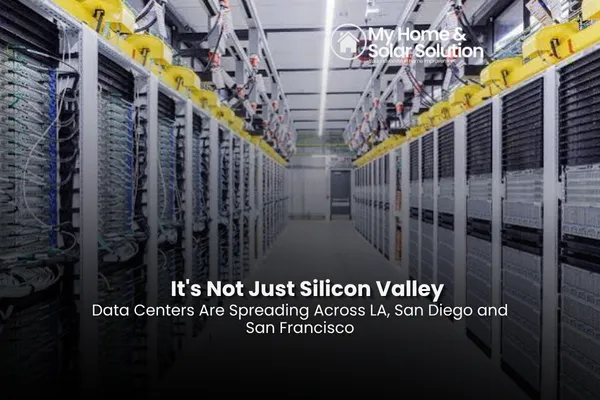
Silicon Valley gets most of the attention, but data centers are spread across California's biggest cities. After Santa Clara's 44 listed facilities, Los Angeles has 19, San Francisco has 12, San Diego has 12, and San Jose has 10. California as a whole is home to at least 287 data centers. That means homeowners in Southern California Edison, San Diego Gas & Electric and PG&E territory all live near the data center boom.
Southern California is in the pipeline too
Southern California Edison has nearly 5,000 megawatts of data center requests in its queue. At full power year-round, that would be about 42 billion kilowatt-hours, or roughly 5.3 million homes' worth of electricity at 8,000 kilowatt-hours per home. Meanwhile, communities in Southern California are pushing back. Monterey Park voters banned data centers in June 2026, and the Ventura County Fairgrounds ended an agreement with a data center developer in September.
San Diego homeowners already pay the most
SDG&E customers face some of the highest average residential rates among California's major utilities. Any new pressure on the grid lands on households that are already stretched. San Diego's 12 listed data centers are part of a statewide trend of growing demand.
Why this matters for every utility customer
Data centers run around the clock, including during the evening hours when solar fades and electricity prices peak. As more large loads connect, utilities need new transmission lines, substations and generation. State consumer advocates have warned that ratepayers could end up covering costs if large projects fail to deliver expected revenue.
Choosing your side of the meter
As AI drives up energy demand, every home will be on one side of the meter. On the buying side, homeowners pay whatever the grid charges. On the supply side, they produce solar power, store it in a battery, and send extra electricity back to the grid for compensation. Some homeowners may dislike the idea of helping supply a grid that serves data centers. But it is better than being on the other side of the meter, absorbing every rate increase.
Making the move without buying equipment
Whether you are an SCE, SDG&E or PG&E customer, qualifying homeowners can get solar and battery storage through third-party ownership programs without buying or financing equipment. With SB 913, California is developing a method to value battery power sent to the grid during high demand.
The takeaway
Data centers are not just a Silicon Valley issue. Homeowners across California can protect themselves by producing and storing their own power, with savings that can reach up to 40 percent compared with utility rates, depending on the home and program.
To find out if your home qualifies for a TPO solar and battery program, visit myhomesolution.org/california_public_utility_commissions

