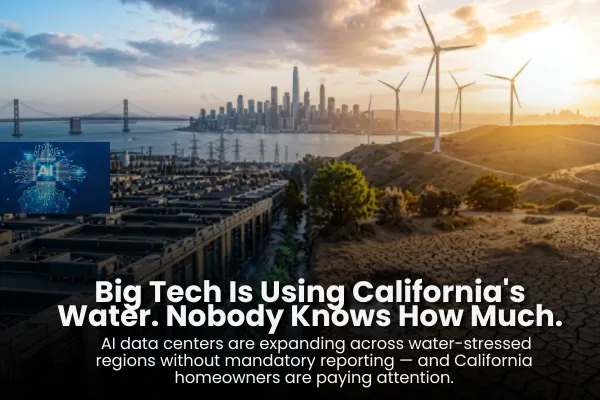
Big Tech Is Using California's Water. Nobody Knows How Much. AI data centers are expanding across water-stressed regions without mandatory reporting — and California homeowners are paying attention.
Big Tech Is Using California's Water. Nobody Knows How Much.
AI Data Centers Are Expanding Across Water-Stressed Regions Without Mandatory Reporting — and California Homeowners Are Paying Attention.
California is in a water crisis that most residents understand viscerally: shorter showers, drought-tolerant landscaping, fines for watering lawns on the wrong days. The state has spent decades managing water as a scarce and precious resource, with detailed tracking, permits, and public reporting requirements for major users. Unless, apparently, you're a data center running artificial intelligence.
A growing body of investigative reporting and academic research has revealed that large-scale AI data centers — operated by Google, Microsoft, Meta, Amazon, and others — consume enormous quantities of water for cooling purposes. And in many cases, there is no mandatory public reporting of how much water they use, where they get it, or what impact their consumption has on regional water supplies. In California, where many of these facilities are located or expanding, that opacity is becoming a flashpoint. And for homeowners already dealing with rising utility bills, water restrictions, and wildfire risk, it's one more reason to pay attention to who is actually driving the energy and resource demands reshaping life in the state.
How Data Centers Use Water
Most large-scale data centers rely on evaporative cooling — essentially, massive industrial air conditioning systems that consume water to keep servers at safe operating temperatures. The hotter the ambient temperature, the more water is needed. A single large hyperscale data center can consume between 1 and 5 million gallons of water per day. Some estimates place the water footprint of training a single large AI language model at hundreds of thousands of liters. As AI workloads have grown exponentially — driven by the boom in large language models, image generation tools, and AI-powered search — the water and energy demands of data centers have scaled accordingly.
The Problem: No One Is Required to Report
Unlike many other large industrial water users in California, data centers in most jurisdictions face no mandatory reporting requirement for their water consumption. They are not required to file public disclosures with water districts. They are not covered by the same permitting transparency rules that apply to agricultural operations or municipal utilities.
What reporting exists is largely voluntary — and it's inconsistent, variable in methodology, and often years out of date. Environmental researchers and investigative journalists who have attempted to track data center water usage have been met with limited access to facility data, vague commitments from corporations, and regulatory gaps that make independent verification nearly impossible. Some California water districts have begun pushing for greater disclosure, and state legislators have introduced bills requiring more transparency. But as of 2026, comprehensive mandatory reporting does not exist — and data center expansion continues apace.
Where in California This Is Happening?
Data centers have historically clustered in the Bay Area and the greater Sacramento Valley — regions with relatively cooler climates and better existing infrastructure. But expansion is pushing into new areas, including parts of the Inland Empire, the Central Valley, and regions where water stress is already a significant concern.
The Inland Empire — which includes parts of San Bernardino and Riverside counties, adjacent to Ventura County — has seen a surge in data center development driven by land availability and connectivity to the Los Angeles metro market. These are not water-rich regions. Many communities in this corridor rely on imported water from the Colorado River and the State Water Project — both sources under increasing pressure due to drought and competing demand.
The irony is visible: in a state that asks homeowners to take shorter showers and replace grass with drought-tolerant plants, some of the world's largest corporations are consuming millions of gallons of water daily to power AI tools — with no public accounting of the impact.
What This Means for Your Electric Bill
The water story is intertwined with an energy story — and that energy story is costing California homeowners money.
AI data centers don't just use water. They use enormous amounts of electricity. California's grid operator, CAISO, has flagged the rapid growth of data center load as one of the most significant planning challenges for grid reliability in the coming decade. More load on the grid means more pressure on electricity prices. Utilities must procure more power to meet peak demand — and much of that power, during high-demand periods, comes from expensive natural gas peaker plants. Those procurement costs flow into rates paid by residential customers. In practical terms: the AI boom is contributing to higher electricity bills for California homeowners. The data centers generating enormous value for tech companies are externalizing some of their infrastructure costs onto the ratepayers who share the grid.
What California Homeowners Can Do?
The policy response to data center water and energy consumption is in progress but slow. Meaningful mandatory reporting, fair cost allocation, and stronger oversight may come — but they won't arrive in time to offset the rate increases already baked into 2026 and 2027 utility rate cases. What California homeowners can do, right now, is take control of their own energy consumption. A solar-and-battery system doesn't eliminate your connection to the grid, but it dramatically reduces how much power you draw from it — particularly during peak hours when grid costs (and your rates) are highest.
By generating your own solar power during the day and storing it in a battery for evening use, you're insulating yourself from the cost pressures that data center load growth is placing on the California grid. Your bill becomes more predictable. Your exposure to future rate increases decreases. And your dependence on a grid that's increasingly strained by industrial-scale AI workloads diminishes.
The Policy Conversation Homeowners Should Be Having
The lack of transparency around data center water and energy use is a legitimate public policy concern — and California homeowners have every reason to push their representatives for greater accountability.
Questions worth asking: Why are data centers exempt from the water reporting requirements applied to farms and municipalities? Who approved the utility interconnection agreements for these facilities, and what rate cost-sharing structures were negotiated? What share of recent rate increases can be attributed to grid upgrades required to serve new large industrial loads?
These aren't rhetorical questions. They're the kinds of inquiries that lead to better policy — and better outcomes for the homeowners who make up the majority of California's ratepayer base.
In the meantime, the best hedge against a grid under industrial strain is to reduce your dependence on it. My Home & Solar Solutions can help you do that.
Visit https://myhomesolution.org/california_public_utility_commissions to learn about solar and battery programs available to qualifying California homeowners. The grid is getting more expensive. Your home doesn't have to be.

