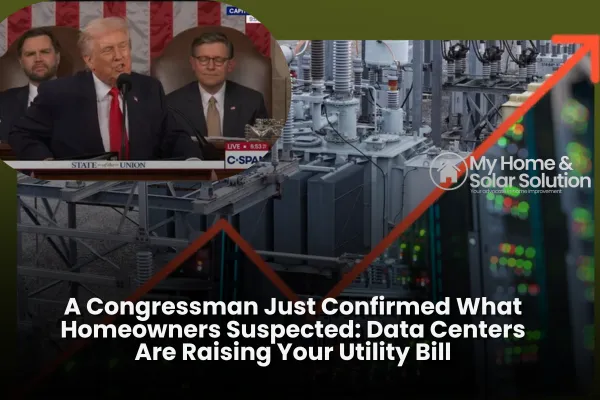
A Congressman Just Confirmed What Homeowners Suspected: Data Centers Are Raising Your Utility Bill
A Congressman Just Confirmed What Homeowners Suspected: Data Centers Are Raising Your Utility Bill
In a recent televised discussion about AI policy and the 2026 midterms, a sitting member of Congress laid out, in plain language, exactly how new AI data center demand translates into higher electric bills for everyday homeowners. The explanation wasn't speculative or theoretical — it described the actual regulatory mechanism that's already playing out across utility territories, including in California.
The Mechanism, Explained Simply
As the Congressman described it: when an energy company needs to build new power infrastructure to serve a large new customer — like an AI data center — it goes to state regulators for approval to build that infrastructure. Once approved, the utility recovers the cost of building it by raising rates across its customer base, including residential homeowners who have no direct connection to the data center driving the need for that investment in the first place. This is a direct, real-world illustration of the cost-of-service regulation model discussed throughout this content series: utilities get approval for infrastructure investment, and that investment gets folded into the rate base that all customers help pay for, regardless of which customer's demand actually drove the need for it.
Why Data Centers Are a Uniquely Large Driver of This Dynamic
What makes AI data centers different from typical new commercial customers is sheer scale. A single large data center campus can require as much new electricity capacity as a small city, often necessitating substantial new transmission and substation infrastructure that wouldn't otherwise be needed on that timeline. When that scale of new infrastructure gets approved and built, the resulting rate base increase — and the corresponding bill impact on existing customers — can be significant. This is precisely the dynamic homeowners across the country have started noticing and asking about: large new data centers announced in their region, followed by utility rate increase filings citing infrastructure investment needs.
Why This Matters Beyond Just One Comment
Public officials acknowledging this mechanism directly, on the record, matters because it moves the conversation from anecdotal homeowner suspicion to an openly recognized policy issue. It suggests this dynamic is likely to become a more prominent part of utility regulation debates and political conversation as AI infrastructure buildout continues to accelerate nationwide.
What Homeowners Can Do
Since this cost-recovery mechanism is built into how utility regulation works, individual homeowners generally can't opt out of contributing to data-center-driven infrastructure costs through their bills. The most direct way to limit exposure is the same strategy that applies to broader rate pressure: reducing how much grid electricity you need to purchase in the first place through solar generation and battery storage, insulating a portion of your energy costs from rate increases driven by demand you have no control over.
Bottom Line
A member of Congress publicly confirmed what many homeowners have suspected: new data center infrastructure costs get passed through to everyday ratepayers via the standard utility rate-approval process. As AI infrastructure continues to expand, this dynamic is likely to remain a significant and growing contributor to utility bills nationwide, including in California.
Visit www.myhomesolution.org to learn more about My Home & Solar Solutions and our partnership with GivePower. Energy and water are inextricably linked. The choices we make about both — here and globally — matter more than ever.

