ComEd's 19th Major Storm of 2026 What Chicago-Area Homeowners Should Plan For
ComEd's 19th Major Storm of 2026
What Chicago-Area Homeowners Should Plan For
Illinois does not have wildfire shutoffs. It has storms. And this summer, the storms keep coming. If you live in ComEd territory, the question is not whether another outage is possible. It is how ready your home is when it happens.
What happened on August 11
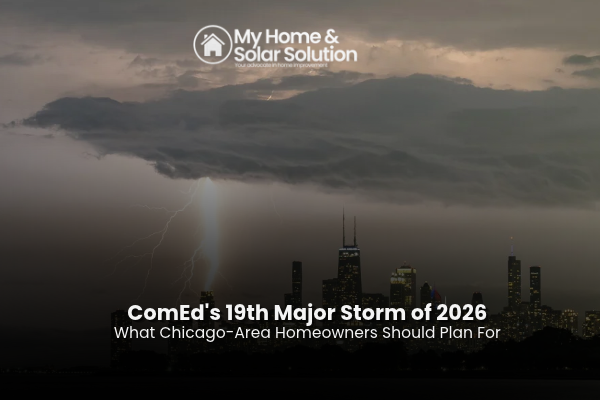
A derecho swept through the Chicago area and Northwest Indiana. According to Axios Chicago, more than 370,000 customers lost power across ComEd and NIPSCO territory, and crews were still restoring service the next day. Tree damage made it harder. Limbs and whole trees tangled in power lines slowed repairs.
A record year for major weather events
Axios reports that this was ComEd's 19th major weather event of 2026, the most in more than two decades. The same report says Illinois became only the second state on record to pass 200 tornadoes in a single year. Governor Pritzker also issued a disaster declaration earlier this summer after storms and tornadoes hit 11 counties, per Axios. A new analysis cited in the story ranks Cook County as the nation's second-least-prepared large county for natural disasters.
What ComEd says
ComEd says the storms show the need for grid investments, including stronger equipment, tree management and technology that automatically reroutes power around outages. That is the utility's position, and those upgrades take years. A consultant quoted by Axios put it plainly: the realistic goal is not a grid that never goes down, but one where severe weather does not keep causing widespread, prolonged outages.
What this means for your home
Better poles and wires help, but they will not stop a fallen tree from taking out your street. Backup power at your own home is the part you control. A solar and battery system can keep the essentials running when the lights go out, such as the refrigerator, internet and phone charging. Solar can also recharge the battery the next day, as long as the sun is out.
How third-party ownership (TPO) works
With third-party ownership, a company installs, owns and maintains the solar and battery system at your home. You pay for the power it produces without buying, leasing, or financing equipment. Many programs are designed to come in below utility rates, with savings of up to 40% depending on your home and program.
Here is what a TPO solar and battery program can offer:
Backup power during storm outages
Stored solar for expensive evening hours
Maintenance handled by the system owner for the term
Wondering what that could look like on your roof? Check your options here.
To find out if your home qualifies for a TPO solar and battery program, visit myhomesolution.org
Axios Chicago, Is Chicago prepared for more powerful storms? Derecho puts region to the test (Aug 12, 2026): https://www.axios.com/local/chicago/2026/08/12/illinois-derecho-tornado-indiana-south-suburbs-trees-power-flooding

