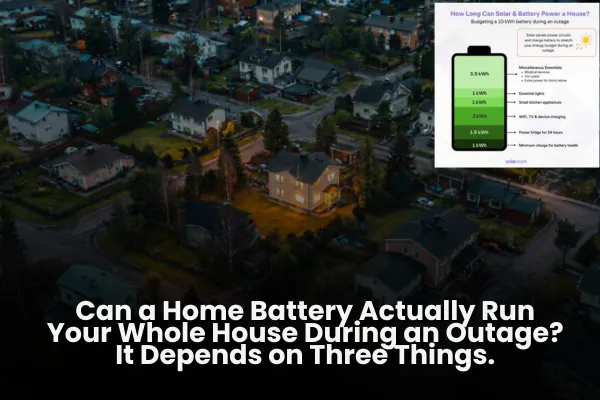
Can a Home Battery Actually Run Your Whole House During an Outage? It Depends on Three Things.
Can a Home Battery Actually Run Your Whole House During an Outage? It Depends on Three Things.
When California homeowners hear "home battery," many imagine a seamless experience: grid goes down, battery kicks on, life continues as normal. The lights stay on. The AC runs. The refrigerator hums. Nobody notices anything except the neighborhood is quiet. That experience is achievable. But it's not automatic — and it's not guaranteed by simply having a battery installed. Whether a home battery can actually run your whole house during an outage depends on three specific factors. Getting all three right is the difference between meaningful resilience and a system that falls short when you need it most.
Factor 1: Battery Capacity
A single Tesla Powerwall 3 holds 13.5 kWh of usable energy. That sounds like a lot — and in some contexts, it is. But a whole-home electricity audit changes the perspective quickly.
Consider a typical 1,800 square foot Southern California home in July:
Central air conditioning (3-ton unit): 3,500W while running
Refrigerator: 150W continuous
Lights (LED throughout): 200W
Router, TV, devices: 200W
Miscellaneous always-on loads: 150W
Total while AC is cycling: approximately 4,200W average demand.
At 4,200W average draw, a fully charged 13.5 kWh Powerwall would last approximately 3.2 hours running everything at once. Overnight without solar recharging — roughly 10 hours of darkness — a single battery isn't enough for whole-home operation if you're running AC. The math changes dramatically with multiple batteries or with solar recharging. Two Powerwalls (27 kWh) extend the same load to 6.4 hours of full consumption without replenishment. Add solar generation of 40 kWh per day in summer, and two batteries sustain whole-home operation indefinitely through multi-day outages.
The capacity question is not, "Do I have enough storage for tonight?" but "Do I have enough storage, combined with solar recharging, to sustain my household through the duration of likely outages in my area."
Factor 2: How the Backup System Is Configured
Not all battery installations are configured for whole-home backup. In fact, many installations default to critical loads backup — protecting only a designated subset of your home's circuits — because it's simpler and less expensive to wire. A critical loads configuration connects your battery to a dedicated backup panel containing only your priority circuits: refrigerator, key lights, router, medical equipment, and a few outlets. Your HVAC, electric vehicle charger, washer, dryer, and non-priority circuits are wired to your main panel and don't receive backup power.
Whole-home backup requires connecting your battery to an automatic transfer switch that can isolate your entire home's electrical system from the grid and supply all circuits from the battery. This requires more sophisticated equipment, proper sizing, and careful installation — but it delivers the seamless experience most homeowners envision. If you want whole-home backup, you need to specify that explicitly when designing your system. Don't assume it's included because you're buying a battery.
Factor 3: Whether You Have Solar to Replenish the Battery
A battery without solar is a one-time tank of electricity. Once it's depleted, it's gone — you won't be able to recharge it until the grid comes back on. A battery paired with solar is a continuously replenishing energy supply. Your panels generate electricity during daylight hours, which flows into the battery even while the grid is down. Depending on system size and your consumption, you may never deplete the battery at all during a daytime outage, and you'll wake up to a fully recharged battery every morning for as long as the grid remains down.
For California homeowners facing PSPS events that can last 24–72 hours, this replenishment capability is the critical factor that separates a battery that's useful for a few hours from one that sustains you through the entire event.
A 10 kW solar array on a clear Southern California day generates approximately 50 kWh — enough to fully charge three Powerwalls and cover most of the day's household load simultaneously. Even on a partially cloudy day, generation of 20–30 kWh is common. That replenishment keeps your backup system viable through multi-day events.
The Configuration Conversation to Have Before You Buy
The question to ask your installer isn't "what size battery do I need?" It's a series of three questions:
"Are you configuring this for whole-home backup or critical loads?"
-If the answer is critical loads and you want whole-home, say so clearly.
"How many hours of whole-home runtime does this configuration provide, assuming my average summer consumption?"
-Get a specific number, not a range, and ask them to show you the load calculation behind it.
"What is the expected daily solar recharge into the battery, and what does that mean for my ability to sustain backup through a 3-day event?"
-This tells you whether you have true resilience or just a buffer.
My Home & Solar Solutions conducts this analysis for every customer before recommending a system configuration. We calculate your specific household loads, your expected solar generation based on your roof and location, and the number of batteries required to achieve the backup duration that makes sense for your situation.
For qualifying Ventura County homeowners, we offer TPO programs that include battery backup with no upfront equipment cost — configured to your household's specific needs, not a generic standard package.
Visit https://myhomesolution.org/california_public_utility_commissions to schedule a free assessment. The answer to "can a home battery run my whole house?" is yes — when the capacity, configuration, and solar replenishment are all right.

