Californians Are Fighting Back Against Data Centers From Ventura to the Imperial Valley
Californians Are Fighting Back Against Data Centers
From Ventura to the Imperial Valley
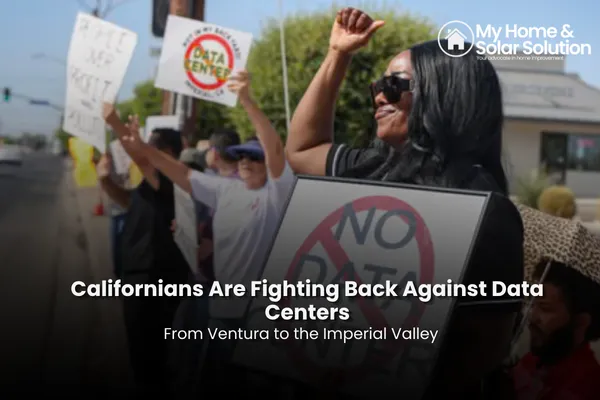
Across California, a pattern is taking shape. A company proposes a data center, residents learn the details, and packed public meetings follow. In 2026 alone, communities from the coast to the desert have pushed back, and in several cases, they have won.
Ventura: a fairgrounds deal ends
In early September 2026, residents learned that the Ventura County Fairgrounds had signed a non-binding memorandum of understanding with Global Stack, an Orange County company. Global Stack described its plan, a shipping-container-sized data processing unit, an aircraft landing area and a parking garage on up to five acres, as emergency resilience infrastructure. Many residents saw it as a data center. At the September 15 board meeting, community members turned out in large numbers. The board gave Global Stack 30 days' notice that it would not proceed with the agreement. Global Stack has said it plans to pitch the same concept to up to 70 fairgrounds across California, including Calistoga, where nearly 100 residents criticized a similar proposal in June.
Imperial County: a pause on the state's biggest proposal
In the Imperial Valley, a proposed 330-megawatt data center, which would be California's largest, drew months of opposition. On June 16, 2026, county supervisors voted unanimously to pause pending and future data center projects while an advisory committee writes new rules.
Monterey Park: voters ban data centers outright
In June 2026, Monterey Park voters approved Measure NDC with about 86 percent support, the first voter-enacted data center ban in the country. The 50-megawatt project that sparked it had been planned less than 500 feet from homes.
What residents keep saying
The concerns repeat from city to city: power demand, water use, diesel backup generators, noise, public land, and the impact on utility rates. Underneath them is a simple worry. Data centers use enormous amounts of electricity, and homeowners do not want to pay more because of it.
The demand is not going away
Even with these local wins, statewide demand continues to rise. Data center developers have requested about 15,000 megawatts from PG&E and nearly 5,000 megawatts from Southern California Edison. The California Energy Commission projects electricity use could climb more than 50 percent by 2045. That means the bigger question for homeowners is not only whether a data center gets built in their town. It is which side of the meter their home will be on as demand grows.
Moving to the supply side
Homes that only buy power from the grid are exposed to every rate increase that follows rising demand. Homes with solar and batteries produce their own electricity, store it for the evening, and send extra power back to the grid for compensation. Not everyone loves the idea of supplying a grid that serves data centers. But being a supplier beats being a customer competing with them for the same electricity. Qualifying California homeowners can now get solar and battery storage through third-party ownership programs without buying or financing equipment. With SB 913 directing regulators to set a value for battery power sent to the grid during high demand, home batteries are becoming a growing asset.
The takeaway
Californians are showing up to protect their communities. The next step is protecting their own homes, with power they control and savings that can reach up to 40 percent compared with utility rates, depending on the home and program.
To find out if your home qualifies for a TPO solar and battery program, visit myhomesolution.org/california_public_utility_commissions

