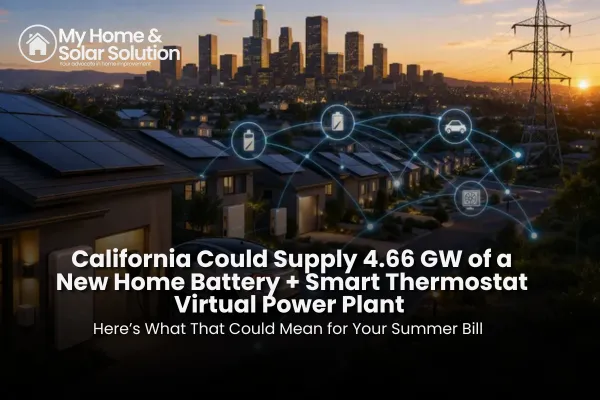
California Could Supply 4.66 GW of a New Home Battery + Smart Thermostat Virtual Power Plant Here’s What That Could Mean for Your Summer Bill
California Could Supply 4.66 GW From a Home Battery Virtual Power Plant
What It Could Mean for Your Summer Bill
California's grid faces its toughest test every summer, when statewide air conditioning demand pushes peak electricity use to its highest levels of the year. A growing solution to that peak demand problem doesn't involve building new power plants at all — it involves connecting thousands of home batteries and smart thermostats into what's called a virtual power plant, with potential capacity estimated at 4.66 gigawatts statewide. For homeowners who already have or are considering battery storage, this represents a meaningful new way to make that investment work harder.
What a Virtual Power Plant Actually Is
A virtual power plant, or VPP, aggregates many small distributed energy resources — home batteries, smart thermostats, and sometimes EV chargers — into a coordinated network that utilities can call on during periods of peak grid stress, similar to how a traditional power plant provides capacity, but without the emissions or construction costs. When the grid operator needs extra capacity during a summer heat event, participating homes can automatically discharge stored battery power or adjust thermostat settings for a brief period, collectively acting like a large power plant.
How Homeowners Get Paid
Utilities and grid operators typically compensate VPP participants either through upfront enrollment incentives, ongoing payments for capacity made available, or per-event payments when a home's battery or thermostat is actually called on to respond. For a homeowner who already has battery storage installed primarily for outage backup, VPP enrollment can turn an asset that otherwise sits idle most of the year into a source of ongoing income, without meaningfully compromising the backup protection it provides during an actual outage.
Why 4.66 Gigawatts Matters?
To put that number in context, a single large natural gas power plant typically produces somewhere in the range of 500 megawatts to 1 gigawatt of capacity. A 4.66-gigawatt virtual power plant built from distributed home batteries and smart thermostats represents capacity roughly equivalent to several traditional power plants, achieved without a single new facility being built — just homeowners' existing or planned equipment being coordinated to support the grid during its highest-stress hours.
What This Means If You're Considering a Battery
For homeowners weighing whether battery storage is worth the investment, VPP participation adds a new revenue stream to the calculation, alongside the existing benefits of outage protection and reduced grid electricity purchases. My Home & Solar Solutions helps California homeowners understand VPP program options in their utility territory and design battery systems that maximize backup protection while remaining eligible for these emerging compensation programs. Visit myhomesolution.org to find out what a battery system could earn for your household this summer.

