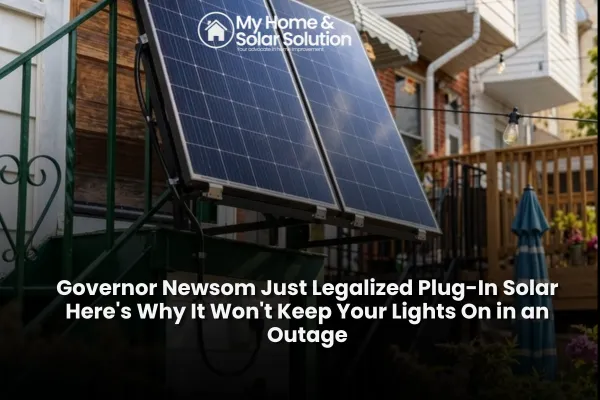
Governor Newsom Just Legalized Plug-In Solar Here's Why It Won't Keep Your Lights On in an Outage
California Just Legalized Plug-In Solar
Here's Why It Won't Keep Your Lights On in an Outage
Governor Gavin Newsom has signed Senate Bill 868, known as the Plug and Play Solar Act. Starting January 1, 2027, California residents will be allowed to install small plug-in solar systems, sometimes called balcony solar, with up to 1,200 watts of total AC output per home. These units plug into a standard outlet and do not require the usual utility interconnection process. The law was written with renters in mind. Roughly 14 million rental units, about 40 percent of California households, could benefit. For an apartment dweller who cannot put panels on the roof, a small plug-in system is a real step forward. But for homeowners trying to protect their families from outages and get control of a rising electric bill, it is important to understand what 1,200 watts can and cannot do.
Plug-in solar shuts off when the grid goes down
Under SB 868, plug-in systems must be UL-certified or equivalent and must automatically shut down during a grid outage. That safety rule protects utility workers repairing lines, but it also means a plug-in panel will not keep your refrigerator, lights, Wi-Fi, or medical devices running when the power goes out. When you need electricity most, the system turns off.
1,200 watts will not make a major dent in a typical home's bill
Analysis cited during the bill's debate found that a single 400-watt balcony system can cover roughly 14 percent of an average apartment's electricity use, saving about $250 per year. That is meaningful for a small apartment. A typical single-family home uses far more electricity, especially with central air conditioning, a pool pump, or an electric vehicle. Even the maximum 1,200 watts would offset only a small slice of that usage, and it produces nothing at night, when time-of-use rates on SCE, SDG&E, and PG&E are highest. A rooftop solar system paired with battery storage is designed to cover a much larger share of a home's usage, store energy for the expensive evening hours, and keep essential loads running during an outage.
Why stacking multiple plug-in units is a bad idea
Some homeowners may think the answer is simple: buy several plug-in kits and plug them into different outlets around the house. That approach does not work, and it can be dangerous. The 1,200-watt limit applies to the total output per dwelling, so multiple units that add up to more than that are not allowed under the law. There is also a practical risk. Household outlets and circuits are designed to deliver power to appliances, not to receive power from multiple generating sources. Feeding too much power back through ordinary circuits can overload wiring, trip breakers, damage the electrical panel, or create a fire hazard. Repairing fried wiring or replacing a damaged panel can easily cost more than the savings those small units were ever going to produce. A properly designed rooftop system is engineered, permitted, and inspected to connect safely to your home's electrical system.
Where California's grid is really heading
The bigger picture is about where the state's power will come from. Southern California Edison's Countdown to 2045 analysis projects that electricity demand in its territory will grow by roughly 80 percent by 2045, while California's climate law requires carbon neutrality by the same year. Meeting that demand with clean power requires enormous amounts of solar and storage, and a distribution grid modernized to support customer-owned energy. Rooftop solar and home batteries are a huge part of that plan.
A full system without buying or financing equipment
Homeowners do not need to settle for a small plug-in panel because they assume a full system is out of reach. Through third-party ownership programs, qualifying homeowners can receive a complete rooftop solar and battery system without buying or financing the equipment, the installation, or the ongoing maintenance. Eligibility depends largely on your home and energy usage. Once installed, you get lower energy costs, backup power during outages, and the opportunity to participate as compensation for energy sent back to the grid continues to grow. Plug-in solar is a good option for renters. For homeowners who want real savings and real protection, rooftop solar with battery storage is the upgrade worth looking into. To find out if your home qualifies for a TPO solar and battery program, visit myhomesolution.org/california_public_utility_commissions

