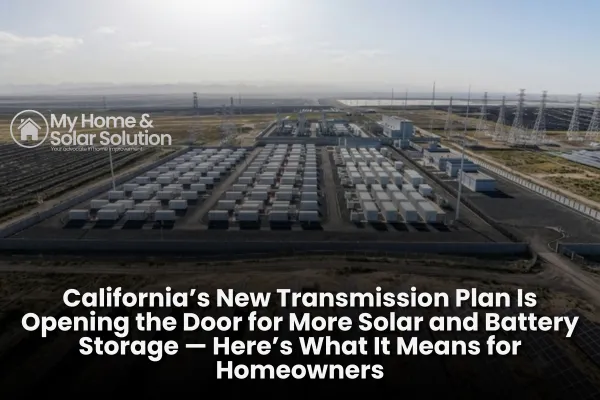
California’s New Transmission Plan Is Opening the Door for More Solar and Battery Storage — Here’s What It Means for Homeowners
California's New Transmission Plan Is Opening the Door for More Solar and Battery Storage — Here's What It Means for Homeowners
California's grid operator, CAISO, and the state's energy planning agencies have been developing what may be the most significant update to California's electricity transmission infrastructure in decades. The state's transmission planning process — which evaluates the new transmission lines, substations, and grid upgrades needed to meet California's clean energy mandates — has identified billions of dollars in new infrastructure investment needed over the next 10–15 years. This transmission build-out is designed to solve a specific problem: the places where California's best renewable energy resources are located — desert solar, mountain wind, offshore wind zones — are far from where California's population lives. Moving that power requires new transmission capacity.
For California homeowners, this large-scale transmission investment has direct implications — for utility rates, for grid reliability, and for the value of distributed solar and storage that reduces dependence on a grid undergoing expensive transformation.
The Transmission Gap California Is Trying to Close
California's renewable energy transition has, for years, been constrained by transmission capacity. The state has abundant solar resources in the Mojave and Sonoran deserts, strong wind resources in mountain passes and coastal areas, and significant offshore wind potential. But moving that power to Los Angeles, the Bay Area, and other population centers requires transmission infrastructure that either doesn't exist or is operating at or near capacity.
The result: during peak solar generation periods, California sometimes has more renewable energy than it can move and use. This phenomenon — called curtailment — wastes clean energy that's already being generated while grid operators must simultaneously keep gas plants running to maintain reliability elsewhere. New transmission infrastructure solves this by creating pathways for renewable energy to flow where it's needed, reducing curtailment, improving reliability, and enabling more renewable capacity to be built cost-effectively.
The Cost Question
Transmission infrastructure is expensive. The California Transmission Planning Group has identified tens of billions of dollars in needed transmission investment over the coming decades. Under California's regulatory structure, these capital costs are socialized across the rate base — meaning residential customers pay for them through their utility bills. This is the same mechanism by which wildfire mitigation costs, distribution upgrades, and new substation construction flow into rates. It's a well-established regulatory principle, but one that compounds the rate pressure California homeowners already face. In practical terms: the new transmission infrastructure being planned and built to enable California's clean energy future will, in the near and medium term, add to the rate pressures homeowners experience. The transmission costs appear in rate cases before the lower-cost renewable energy they enable has fully replaced more expensive legacy generation.
How Distributed Solar Reduces Transmission Dependency
Here's the important parallel for homeowners: distributed rooftop solar reduces the need for transmission infrastructure by generating power close to where it's consumed.
A solar panel on a Ventura County rooftop generates electricity that travels zero transmission distance to the home that consumes it. It doesn't use the long-distance transmission lines being planned between the Mojave Desert and the Los Angeles Basin. It doesn't contribute to congestion in the transmission system. It doesn't require new substations. Every kilowatt-hour generated by distributed rooftop solar is a kilowatt-hour that doesn't need to be transmitted from a remote renewable source. At sufficient scale, distributed rooftop solar actually reduces the total transmission investment California needs to make — and therefore reduces the ratepayer cost of the clean energy transition.
The CPUC has recognized this "location value" of distributed generation in its policy frameworks. Rooftop solar's local generation benefit is one reason the CPUC supports residential solar programs despite opposition from utilities that would prefer to recover all infrastructure costs through rate base investments.
What the Transmission Plan Means for Battery Storage
The new transmission plan also highlights the role of distributed battery storage in California's grid future. As more intermittent renewable generation enters the system, the need for flexibility — the ability to shift power consumption or discharge stored energy in response to grid conditions — increases. Distributed home batteries provide that flexibility at the local distribution level, where large transmission assets can't help. A home battery that charges during periods of high solar generation (when transmission might otherwise be congested with cheap desert solar) and discharges during peak demand (when transmission is strained by high load) is performing exactly the kind of local grid balancing that transmission infrastructure can't easily provide. As California's grid operator develops more sophisticated programs to aggregate and compensate distributed battery assets for this grid service, homeowners with batteries will have additional opportunities to earn value beyond standard bill savings.
The Opportunity for Homeowners Now
California's transmission planning horizon is measured in decades. The transmission infrastructure being planned today won't be fully built until the 2030s and 2040s. In the meantime, homeowners who go solar are:
Reducing their dependence on the transmission infrastructure that's both expensive and under stress. Generating clean energy locally without the transmission losses that remote renewable projects incur. Positioning their homes to participate in the increasingly sophisticated distributed energy resource programs that California's grid modernization is creating.
For qualifying California homeowners in Ventura County and surrounding communities, the opportunity to go solar-plus-battery with no upfront cost exists right now — before the next round of rate increases and before program terms change.
Visit https://myhomesolution.org/california_public_utility_commissions to learn more. California's transmission plan is opening the grid's future. Your roof can be part of that future today.

