California Survived Its Hottest August Thanks to Batteries Here's What That Means for Your Home
California Survived Its Hottest August Thanks to Batteries
Here's What That Means for Your Home
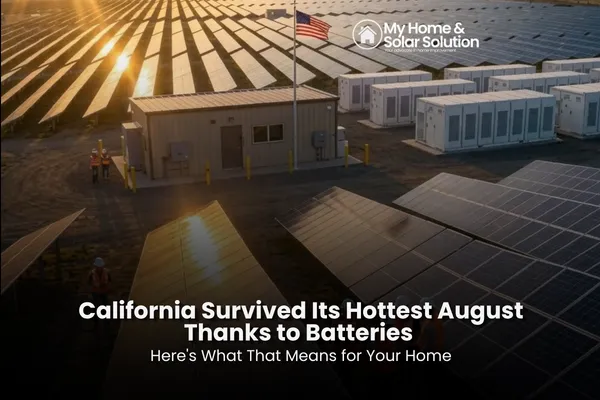
California just made it through the hottest August on record without a single rolling blackout or Flex Alert. That is a dramatic change from 2020, when a severe heat wave led to rotating outages across the state. The difference, according to grid officials, comes down largely to one technology: batteries.
From 100 megawatts to 17,000
In 2020, the California Independent System Operator had less than 100 megawatts of battery storage available. Today it has more than 17,000 megawatts. As CAISO spokesperson Jayme Ackemann put it, in about five years the state has vastly increased the amount of battery storage available. The grid handled peak demand of more than 50,000 megawatts this August without emergency measures. California also generated more than half of its power from solar in May 2026, and rooftop solar installations added further capacity.
How batteries got the state through
The strategy is simple. Batteries store solar energy produced during the day and release it during the evening and early morning, when air conditioners are running hard and solar output has dropped. That timing is critical, because the hours after sunset are when the grid is most vulnerable. Officials still caution that unforeseen events, such as wildfires damaging generation or transmission, could require emergency measures in some areas. A stronger statewide grid does not guarantee that every neighborhood will keep power during every emergency.
The same strategy works at home
What worked for California's grid works for individual homes too. A rooftop solar system paired with a home battery follows the exact same playbook. Panels produce power during the day, the battery stores it, and your home uses that stored energy in the evening. For homeowners on SCE, SDG&E, and PG&E, that brings two benefits. The first is savings, because evening hours are the most expensive on time-of-use plans, and stored solar replaces power you would otherwise buy at peak prices. The second is protection, because if a local outage or public safety power shutoff hits your neighborhood, your battery keeps essential loads running, even when the statewide grid is fine. Home batteries also strengthen the grid itself. During this year's September heat wave, more than 140,000 home batteries sent over 580 megawatts to the grid in a single evening.
No purchase required
Through third-party ownership programs, qualifying homeowners can get solar and battery storage installed without buying or financing equipment, while enjoying lower energy costs and backup power. Batteries have proven they can carry California through record heat. If you want the same protection and savings for your own home, see if you qualify.
To find out if your home qualifies for a TPO solar and battery program, visit myhomesolution.org/california_public_utility_commissions

