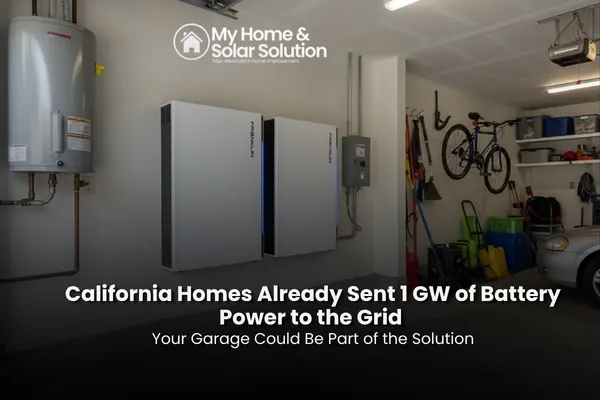
California Homes Already Sent 1 GW of Battery Power to the Grid Your Garage Could Be Part of the Solution
California Homes Already Sent 1 GW of Battery Power to the Grid
Your Garage Could Be Part of the Solution
One of California's most effective tools for keeping the lights on during heat waves is not a power plant. It is a network of home batteries. The state's Demand Side Grid Support program, known as DSGS, has brought more than 1 gigawatt of collective capacity online, according to reporting from Canary Media, enough to rival a large conventional power plant.
How the program works
Launched in 2022 and run by the California Energy Commission, DSGS pays households and businesses that are willing to reduce their power use or share solar energy stored in their batteries when the grid is under stress. Roughly 130,000 homes with batteries are enrolled, along with nearly 75,000 homes with smart thermostats and other flexible devices. The results have been impressive. During a July 2025 test, batteries charged by rooftop solar delivered roughly 476 megawatts of grid capacity over two hours. And on September 9, 2026, more than 140,000 home batteries discharged over 580 megawatts during a heat wave, the largest residential virtual power plant dispatch on record.
Why it matters during heat waves
The hardest hours for California's grid come on hot evenings, when air conditioning demand is high and solar output is fading. Home batteries charged during the day can release energy exactly when it is needed most, reducing the need for expensive, polluting peaker plants. The program's future funding has been uncertain. Its budget was cut in 2024 and 2025, and lawmakers had to transfer money from another program to keep it running through 2026. As of September 2026, there was no guaranteed funding for next year. Even so, the program has proven what home batteries can do, and the state has since signed SB 913, which directs regulators to create a method for valuing customer batteries that export power during periods of high demand.
What this means for homeowners on SCE, SDG&E, and PG&E
Home batteries are no longer an experiment. They are a proven grid resource, and California is building policy around them. For homeowners, a battery delivers value on several levels at once. It stores solar energy for use during expensive evening hours, keeps essential loads running during outages, and positions your home to participate in grid support programs as they evolve, subject to eligibility and program rules. Having a battery in your garage puts you on the inside of where California's grid is heading, rather than simply paying for the changes on your bill.
Getting a battery without buying one
Through third-party ownership programs, qualifying homeowners can get solar and battery storage installed without buying or financing equipment, while enjoying lower energy costs and backup power. California homes have already shown they can power the grid when it counts. If you want your home to be part of that solution, see whether you qualify.
To find out if your home qualifies for a TPO solar and battery program, visit myhomesolution.org/california_public_utility_commissions

