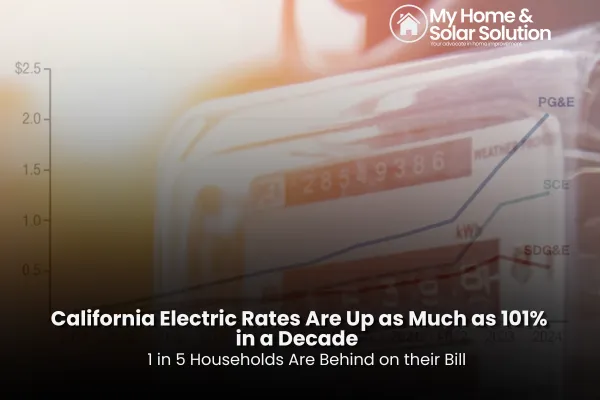
California Electric Rates Are Up as Much as 101% in a Decade — 1 in 5 Households Are Behind on Their Bill
California Electric Rates Are Up as Much as 101% in a Decade
1 in 5 Households Are Behind on Their Bill
A new quarterly report from the California Public Utilities Commission's Public Advocates Office lays out, in stark terms, just how much California electricity has cost over the past ten years. Residential rates have climbed between 69% and 101% since roughly 2016, depending on utility territory — with customers in some parts of the state paying more than double what they paid a decade ago for the same electricity.
See Historical Rate Increase Here
The report breaks the increases down by utility. PG&E, SCE, and SDG&E have each raised residential rates well beyond the pace of inflation, which rose about 30-35% over the same period nationally. The gap between electricity cost growth and general inflation has widened almost every year since 2019. Perhaps the most concerning figure in the report isn't the rate increase itself, but its effect: an estimated 1 in 5 California households are now behind on their electric bill. That's a signal that rate growth has outpaced what a meaningful share of the state's population can comfortably absorb, even with existing assistance programs like CARE and FERA.
What's Driving the Increases
The Public Advocates Office and independent energy economists point to a few consistent drivers behind California's climbing rates:
Wildfire mitigation and liability costs. Since 2018, utilities have spent tens of billions of dollars on grid hardening, vegetation management, and wildfire insurance — costs that get built into the rate base and passed to ratepayers.
Transmission and distribution infrastructure. Aging grid infrastructure requires ongoing capital investment, and utilities earn a guaranteed rate of return on that infrastructure spending, which creates an incentive to invest heavily. Public purpose programs. A portion of every bill funds low-income assistance programs, energy efficiency incentives, and other public policy programs layered onto the base rate. Notably, independent analyses — including a widely cited reanalysis of the "solar cost shift" claims — have found that rooftop solar isn't a significant driver of these increases, despite utility framing that has sometimes suggested otherwise. Utility overhead and infrastructure spending account for the overwhelming majority of the rate growth.
What This Means If You're a California Homeowner
For homeowners already feeling the pinch of high electric bills, this report is a useful reality check: the trend isn't temporary, and it isn't primarily about your usage. It reflects structural cost growth in how utilities are funded and regulated in California — costs that are likely to keep climbing as wildfire risk, grid investment, and public programs all continue to expand. That's part of why more California homeowners are choosing to generate and store more of their own power rather than depend entirely on the grid for it. Solar paired with battery storage doesn't eliminate a utility bill, but it can meaningfully reduce exposure to rate increases that are, by the state's own numbers, running well ahead of inflation and showing no sign of slowing down.
My Home & Solar Solution can walk you through what your specific utility rate structure means for your home, and whether solar and battery storage would meaningfully offset the rate increases documented in this report. Visit myhomesolution.org to get a personalized look at the numbers.

