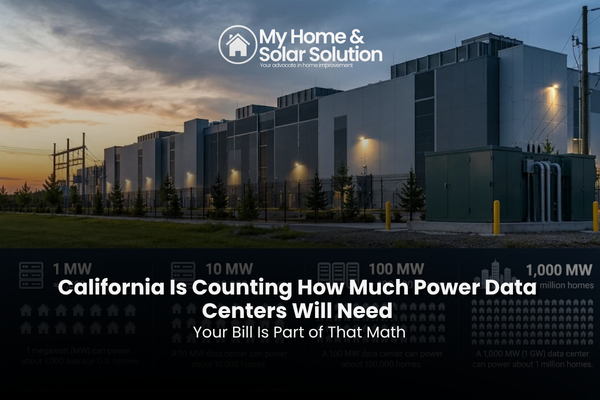
California Is Counting How Much Power Data Centers Will Need Your Bill Is Part of That Math
California Is Counting How Much Power Data Centers Will Need
Your Bill Is Part of That Math
Behind your monthly bill sits a forecast most homeowners never see. This fall, California is updating it.
The problem: a big new customer is lining up for the grid
The California Energy Commission (CEC) is holding a public working group meeting on November 4, 2026 to review draft results for its 2026 demand forecast. Data centers are on the agenda, alongside home solar and storage, electric vehicles and the shift away from gas. The CEC page lists the topics but no data center figures. Its August staff slides give a picture of the starting point.
The numbers staff have shared
As of December 2025, the CEC slides put California's data centers at about 300 facilities drawing roughly 1 GW, or about 2% of the CAISO system peak. Utilities in the CAISO area reported about 23,278 MW of data center requests. Of that, 5,086 MW are signed agreements, 9,587 MW are active applications and 8,604 MW are early inquiries. Not every request gets built. The CEC applies confidence weights, which in its 2025 forecast counted signed agreements more heavily than inquiries.
What this means for your bill
The forecast does not set your rate. The CEC slides say it supports planning for resource adequacy and transmission, and the schedule points to a draft overall forecast on December 14 and proposed adoption in January 2027. But those plans guide what the grid has to build and buy. Homeowners are the ones who see the costs on their monthly statement, so it pays to watch the numbers. A practical way to lower your exposure. You cannot change the forecast. You can change how much power you buy from the grid at retail prices.
How third-party ownership (TPO) works
In a TPO program, a company installs, owns and maintains the solar and battery system at your home. You pay for the power it produces without buying, leasing, or financing equipment. Many programs are designed to come in below utility rates, with savings of up to 40% depending on your home and program.
Here is what a TPO solar and battery program can offer:
-Less dependence on grid power at retail prices, whether you are with SCE, SDG&E or PG&E
-Stored solar for evening hours, when rates are typically highest
-Backup power during outages, with maintenance handled by the provider
-Availability depends on your home and utility, so see what fits your situation.
To find out if your home qualifies for a TPO solar and battery program, visit myhomesolution.org
California Energy Commission, 2026 IEPR load modifiers draft results meeting (Nov. 4, 2026): https://www.energy.ca.gov/event/meeting/2026-11/ca-energy-demand-forecast-2026-iepr-load-modifiers-draft-results
California Energy Commission, Data center data collection and forecasting (Aug. 12, 2026): https://www.energy.ca.gov/sites/default/files/2026-08/Data_Center_Data_Collection_and_Forecasting_ada.pdf

