New California Laws Make Data Centers Cover Their Grid Costs Here's What Your Bill Does Until 2028
New California Laws Make Data Centers Cover Their Grid Costs
Here's What Your Bill Does Until 2028
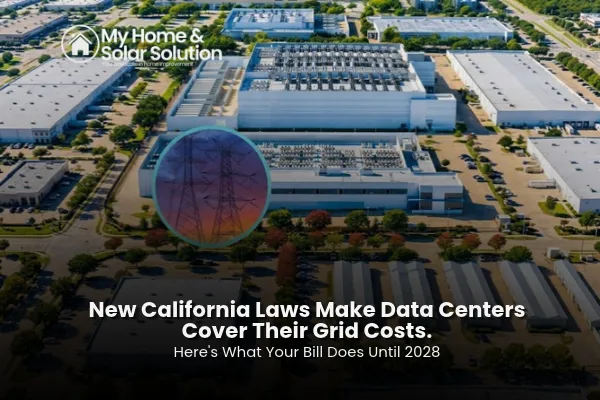
Everyone has heard that AI data centers are straining the grid. The question homeowners keep asking is simpler: who pays for it? On September 21, 2026, Governor Newsom signed a package of data center bills aimed at that exact question. The catch is timing. Most of the new protections do not take hold right away.
What the new laws do
One of the key bills, SB 886, requires the California Public Utilities Commission (CPUC) to set new tariffs for data centers by January 1, 2028. Those tariffs are meant to make data center operators pay for the infrastructure upgrades and generation tied to their service, according to law firm Mayer Brown's summary. The law also adds an early termination fee if a data center leaves the system within 10 years of connecting. The goal is to keep leftover costs from landing on existing customers. A companion bill, AB 2383, goes after the demand itself. Its author says data centers account for about 6.7 gigawatts of new demand, roughly the electricity use of more than 4 million households.
Why your bill won't change overnight
A 2028 deadline means there is a gap. Until the new tariffs are written and approved, the grid keeps growing and the costs of that growth keep flowing through utility rates. That is a long time to wait on a rule change. Your SCE, SDG&E or PG&E rates can still move in the meantime.
What homeowners can control now
You cannot write the tariff. You can reduce how much of your power comes from the grid at the most expensive hours, and you can keep the lights on when the grid is stressed. Solar paired with a battery does both. The panels cover daytime use, and the battery holds that energy for the evening and for outages.
How third-party ownership (TPO) works
With a TPO program, a company installs, owns and maintains the solar and battery system on your home. You pay for the power it produces without buying, leasing, or financing equipment. Many programs are designed to come in below utility rates, with savings of up to 40% depending on your home and program. If you want to see what that could look like, compare TPO solar and battery options and check:
Battery size: enough to cover your evening use and key circuits during an outage.
Maintenance: who handles service for the full term.
Transferability: what happens if you sell your home.
Not sure where to start? Run a quick qualification check for your address. To find out if your home qualifies for a TPO solar and battery program, visit myhomesolution.org
Office of Governor Gavin Newsom, signing announcement, Sept. 21, 2026: gov.ca.gov
Mayer Brown, California's Governor Signs Nation's Most Comprehensive Data Center Laws, Sept. 28, 2026: mayerbrown.com
Assemblymember Zbur press release on AB 2383: zbur.asmdc.org

