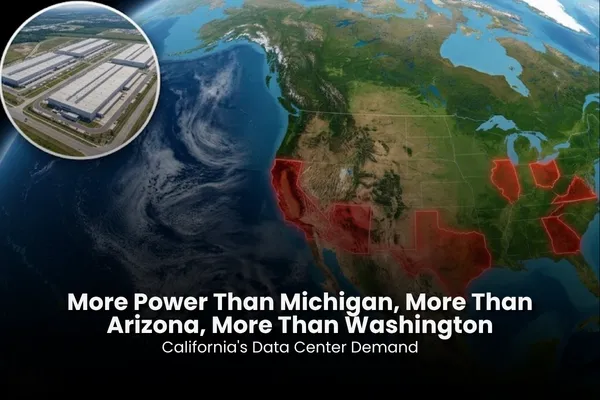
More Power Than Michigan More Than Arizona More Than Washington California's Data Center Demand
More Power Than Michigan More Than Arizona More Than Washington California's Data Center Demand
Michigan is home to about 10 million people and a major manufacturing economy. Arizona has some of the hottest summers in the country. Washington powers Seattle and its tech industry. Yet the electricity data center developers are requesting in California is larger than what any one of those states uses in a year.
The comparison
According to the U.S. Energy Information Administration, Michigan used about 99 billion kilowatt-hours of electricity in 2024. Arizona used about 91 billion, and Washington about 90 billion. Data center developers have asked PG&E for about 15,000 megawatts of power. Running at full power year-round, that would be about 131 billion kilowatt-hours, more than Michigan, Arizona or Washington. Many of those requests are speculative and will not all be built. But signed agreements alone reached about 4,000 megawatts by the end of 2025, about 35 billion kilowatt-hours a year at full power.
What that scale means for the grid
To serve demand on the scale of an entire state, California would need major new investment in transmission, substations and generation. The California Energy Commission already projects statewide electricity use could rise more than 50 percent by 2045. Data centers also run around the clock, which means they keep drawing power during the evening hours when California's grid is most strained and electricity prices are highest.
What it means for your bill
California electricity already averages about 30 cents per kilowatt-hour, second only to Hawaii. State consumer advocates have warned that if data center projects fall short of expectations, ratepayers could be left paying for billions in grid upgrades. Utilities argue the opposite, that more large customers can help spread costs. Homeowners should plan for pressure on rates either way.
Two sides of the meter
As AI drives up energy demand, every home will land on one side of the meter. On the buying side, you pay the grid's price as demand grows. On the supply side, you produce solar power, store it in a battery, and send extra electricity back to the grid for compensation. It is understandable if homeowners dislike supplying a grid that serves data centers. But it is better than being on the other side of the meter, buying from a grid serving a state-sized load.
How homeowners are getting there
Qualifying homeowners can get solar and battery storage through third-party ownership programs without buying or financing equipment. California's SB 913 also directs regulators to set a value for battery power sent to the grid during high demand.
The takeaway
California's data center demand is bigger than entire states. Homeowners can protect themselves with power they produce and store, and savings that can reach up to 40 percent compared with utility rates, depending on the home and program.
To find out if your home qualifies for a TPO solar and battery program, visit myhomesolution.org/california_public_utility_commissions

