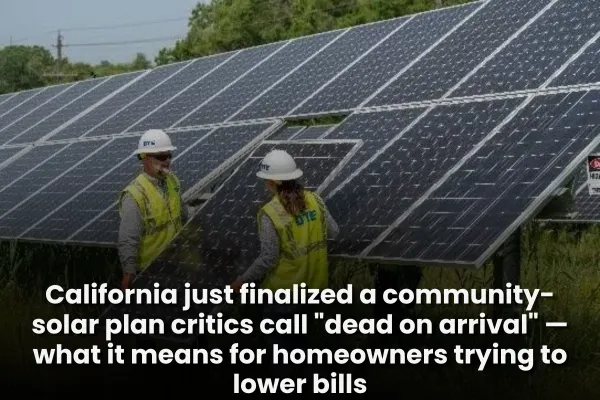
California just finalized a community-solar plan critics call "dead on arrival" — what it means for homeowners trying to lower bills
California Just Finalized a Community-Solar Plan Critics Call "Dead on Arrival
## What it means for homeowners trying to lower their bills — and why your own roof may still be the better path.
California just made a decision that was supposed to expand clean energy access for millions of people. Instead, many of the people who fought hardest for it are calling it a failure before it even begins.
The state finalized its long-awaited community-solar program — and according to reporting in pv magazine, critics are calling the plan "dead on arrival." The structure, they argue, makes it nearly impossible for developers to build the projects the program was meant to create. For homeowners hoping community solar would finally lower their bills, that's a frustrating outcome. But it also points to a clearer truth about where real savings actually come from.
First, what community solar was supposed to do.
The idea is simple and genuinely appealing. Not everyone can put panels on their own roof — renters, apartment dwellers, people with shaded or north-facing roofs. Community solar lets those households subscribe to a share of a larger solar project somewhere else and receive credits on their utility bill for the power it produces.
In theory, it opens clean energy savings to people who could never access rooftop solar.
In practice, the economics have to work for the projects to ever get built. And that's where critics say California's final plan falls apart.
The concerns center on a few core problems:
* Compensation structures that make projects difficult to finance
* Program rules that critics say don't pencil out for developers
* A design that may discourage the very buildout it was meant to create
* Limited near-term benefit for the households it was intended to help
When a program doesn't work for the companies that have to build it, the projects simply don't get built. And subscribers can't save money on solar that never gets installed.
For California homeowners watching this unfold, there's an important takeaway.
The most reliable way to lower your electric bill isn't waiting on a state program that may or may not deliver — it's generating and storing power at your own home.
Community solar, when it works, spreads a small benefit across many subscribers. Rooftop solar paired with battery storage keeps the full benefit at your own address — and gives you something community solar never can: control.
When your panels generate power during the day and a battery stores it for the expensive evening hours, you're not subscribing to a distant project and hoping the credits show up. You're directly reducing how much you buy from the grid, especially during peak-rate windows when SCE, SDG&E, and PG&E charge the most.
That's the difference between a credit on a bill and [real control over the cost of powering your home](https://myhomesolution.org/home-7068).
[**For homeowners trying to actually lower their bills, rooftop solar plus battery storage offers what community programs often can't:**](https://myhomesolution.org/home-7068)
* Direct reduction of expensive peak-hour grid imports
* Savings that stay at your home instead of being spread thin
* Backup power during outages and PSPS events
* Protection from future utility rate increases
* No dependence on whether a state program ever delivers
There's also the question of access. One of community solar's main selling points was helping households that can't afford a big upfront purchase.
But that barrier already has a solution that doesn't depend on a struggling state program.
Qualifying homeowners served by SCE, SDG&E, or PG&E may be able to access [TPO solar and battery programs](https://myhomesolution.org/home-7068) with no large upfront equipment purchase. A separate company owns and installs the system, the homeowner uses the power it produces, and there's no equipment debt or maintenance responsibility — the same accessibility community solar promised, delivered directly to your own roof.
California's community-solar plan may eventually be revised. Programs get rewritten, and pressure from critics can lead to better rules down the road.
But homeowners trying to lower their bills today don't have to wait for that.
The path that's working right now isn't a subscription to a project that may never be built. It's generating your own power, storing it, and using it when it matters most.
To find out if your home qualifies for a TPO solar and battery program, visit [myhomesolution.org](https://myhomesolution.org/home-7068)
Additional resources:
[pv magazine: California Community Solar Coverage](https://www.pv-magazine.com/2026/06/15/california-doubles-down-on-unworkable-community-solar-program/)
[CPUC Net Billing Information](https://www.cpuc.ca.gov/industries-and-topics/electrical-energy/demand-side-management/customer-generation/net-energy-metering-and-net-billing)
[My Home & Solar Solution News](https://news.myhomesolution.org/news)
[Learn More About Solar + Battery Programs](https://myhomesolution.org/home-7068)

