California Just Crossed 21,000 MW of Battery Storage What 300,000 Smaller Systems Mean for Home Backup and Peak-Demand Costs
California Just Crossed 21,000 MW of Battery Storage
What 300,000 Smaller Systems Mean for Home Backup and Peak-Demand Costs
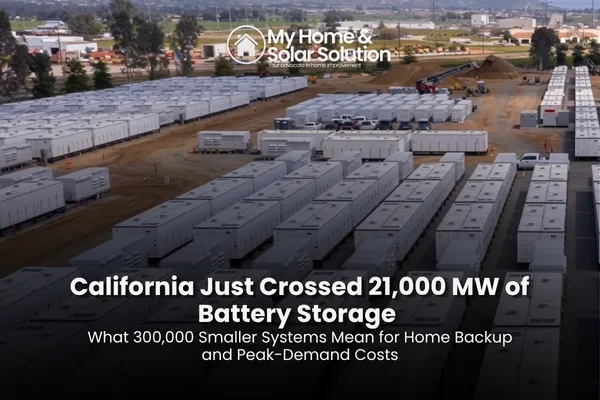
California has quietly built one of the largest battery fleets on the planet. According to the California Energy Commission, the state now has 21,112 megawatts of battery storage supporting its grid, up from less than 700 megawatts in 2019. That is an increase of more than 2,500 percent in about seven and a half years. Most of that capacity sits in large, utility-scale projects. Nearly 16,000 megawatts come from 310 big battery installations inside California, and another 2,000 megawatts come from projects in Nevada and Arizona that serve the state. But the part of the story that matters most for homeowners is the third slice: more than 3,000 megawatts spread across over 300,000 smaller systems installed at homes, businesses, farms, and schools. In other words, a meaningful share of California's grid backup is now sitting in garages and on side walls of houses across the state.
Why 21,000 megawatts is a big deal
To put the number in perspective, the Energy Commission says the state's battery fleet now equals roughly one-third of California's record peak demand, which topped 63,000 megawatts during the September 2022 heat wave. Those are the evenings when air conditioners run hard, the sun is going down, and the grid is under the most strain. California's batteries also tend to be built for longer runs. The state reports that most of its fleet is made up of four-hour systems, which can deliver roughly twice the energy of the two-hour systems more common in Texas, even when the installed capacity looks similar on paper. That extra duration is exactly what the grid needs to bridge the gap between afternoon solar production and late-evening demand. The broader energy mix is shifting too. In the first half of 2026, solar generation surpassed natural gas in California for the first time. Comparing January through June of 2024 with the same months in 2026, solar use grew 22 percent, natural gas use dropped 51 percent, and battery storage capacity jumped 80 percent. The equipment itself has also become far less expensive. The state notes that solar costs have fallen about 97 percent over 25 years, from roughly $5 per watt in 2001 to about $0.15 per watt in 2025, while lithium-ion battery prices have dropped more than 90 percent over the past decade. And the build-out is not slowing down. California projects it will need about 52,000 megawatts of battery and long-duration storage by 2045 to reach its 100 percent clean electricity goal. Today's fleet covers about 41 percent of that target, which means the state is still looking for a lot more storage, including storage at homes.
What this means if you are on SCE, SDG&E, or PG&E
Here is the part that rarely makes the headlines. Even as the grid gets cleaner and more resilient, the cost of delivering power during peak hours remains high. Most residential customers of Southern California Edison, San Diego Gas & Electric, and Pacific Gas and Electric are on time-of-use plans, where the most expensive electricity typically lands in the late afternoon and evening. That is the same window when the statewide grid leans hardest on batteries. Utilities and the state are investing billions in storage precisely because evening power is valuable. A home with its own battery can capture that same value on a smaller scale. Instead of buying expensive grid electricity from 4 p.m. to 9 p.m., a solar and battery home can store its own midday solar production and use it after sunset. That shift can lower monthly bills and reduce exposure to future rate increases. The 300,000 smaller systems in the state's count also show something else: home batteries are no longer a niche product. They are part of how California keeps the lights on. Many homeowners with batteries can enroll in programs that let their systems support the grid during heat waves and Flex Alert events, turning a backup device into a resource that the grid actually values.
Home backup when the grid goes down
Bill savings are only part of the picture. Californians on all three major utilities have lived through public safety power shutoffs, wildfire-related outages, and heat-wave strain. A home battery paired with rooftop solar can keep essentials like the refrigerator, lights, Wi-Fi, medical devices, and phone chargers running when the grid is down, and solar can help recharge the battery during the day. Large utility-scale batteries help keep the overall grid stable, but they cannot keep power flowing to your specific house if a local line is de-energized. A battery on your own wall can.
The practical takeaway for homeowners
California's battery milestone confirms what many homeowners have already figured out: storing solar energy and using it during the most expensive hours is one of the most effective ways to manage a rising electric bill. The state is betting heavily on that strategy at grid scale, and homeowners can apply the same idea at home. The good news is that ownership is not the only path. Third-party ownership programs, often called TPO, allow qualifying homeowners to get solar and battery storage installed without buying or financing equipment. The system is owned and maintained by a provider, and the homeowner pays for the energy or service, often at a rate designed to come in below what they currently pay their utility. Depending on the home, usage, and program, savings can reach up to 40 percent compared with utility rates.
As California pushes toward 52,000 megawatts of storage, homes with solar and batteries are becoming part of the solution rather than just customers of it. If your evening bills keep climbing or you want dependable backup during the next outage, now is a good time to see what a solar and battery system could look like for your home. To find out if your home qualifies for a TPO solar and battery program, visit myhomesolution.org/california_public_utility_commissions

