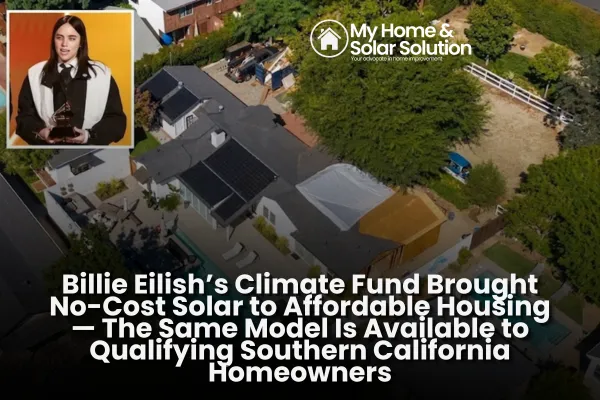
Billie Eilish’s Climate Fund Brought No-Cost Solar to Affordable Housing — The Same Model Is Available to Qualifying Southern California Homeowners
Billie Eilish's Climate Fund Brought No-Cost Solar to Affordable Housing — The Same Model Is Available to Qualifying Southern California Homeowners
When Billie Eilish's REVERB-partnered climate fund helped bring no-cost solar panels to affordable housing units in Los Angeles, it made headlines for the right reasons: clean energy becoming accessible to families who had historically been left out of the solar revolution. The coverage celebrated the philanthropic aspect. What was less widely reported: the underlying program model — third-party ownership with no upfront cost for qualifying residents — isn't unique to celebrity-funded initiatives. It's a California policy structure that's available right now to qualifying homeowners across Southern California, without the need for a foundation grant or famous sponsor.
Here's how that model works, who qualifies, and what it could mean for your electric bill.
The Logic Behind No-Cost Solar for Qualifying Households
California's push to expand solar access to low-to-moderate income (LMI) households isn't charity — it's policy. The California Public Utilities Commission has recognized for years that rooftop solar's environmental and economic benefits have largely accrued to higher-income households, while lower-income families continue to pay a disproportionate share of their income on utility bills. Programs like SOMAH (Solar on Multifamily Affordable Housing), DAC-SASH (Disadvantaged Communities Single-family Affordable Solar Homes), and various CPUC-approved third-party ownership structures were designed to close that gap by removing the financial barriers that kept solar out of reach for qualifying families.
The mechanism in these programs is essentially the same one that powers market-rate TPO solar:
A program partner — using a combination of utility incentives, federal tax credits, and program funding — installs solar (and increasingly, battery storage) on qualifying homes at zero upfront cost to the resident or homeowner. The resident or homeowner pays a reduced monthly energy fee significantly below their current utility bill. The program partner owns and maintains the equipment for the life of the agreement. For the celebrity-backed housing project Eilish's fund supported, the mechanism was similar: third-party capital absorbed the equipment cost in exchange for a long-term energy service agreement with below-market rates for residents.
Who Qualifies in Southern California
The programs available to Southern California homeowners span a range of income levels and eligibility criteria:
CPUC LMI programs: Primarily targeted at households earning less than 80% of Area Median Income (AMI). These programs offer the most subsidized terms, sometimes including equipment at zero cost with no ongoing payment required. Market-rate TPO with utility incentive stacking: Available to a broader range of homeowners who don't necessarily qualify for LMI programs but can access TPO agreements that combine the federal Investment Tax Credit, SCE net billing incentives, and program partner economies of scale to offer below-market energy rates without upfront cost. Disadvantaged community programs: Geographic eligibility based on California's CalEnviroScreen tool, which identifies communities with disproportionate environmental and economic burdens. Many areas in Ventura County and surrounding communities qualify under these designations. The practical reality: homeowners paying over $150/month to SCE who own their home and meet credit eligibility requirements for their specific program can almost certainly access a TPO solar-plus-battery program at no upfront cost. Whether they qualify for LMI-specific programs adds additional subsidy on top.
Why Battery Storage Is Part of the Picture
The reason celebrity and foundation-backed programs — and CPUC-approved programs for qualifying households — increasingly include battery storage is straightforward: batteries are what make solar meaningfully impactful for families who can't afford a power outage. An affordable housing resident who goes solar without storage has lower bills on sunny days but no protection when the grid goes down — including during the PSPS events that disproportionately affect disadvantaged communities in California's fire-prone regions. Battery storage is the upgrade that turns solar from a billing tool into a genuine resilience tool. And for low-to-moderate income households, resilience during grid outages isn't a luxury. A family whose breadwinner works from home and loses internet during a PSPS event, or whose elderly family member needs powered medical equipment, faces real hardship. The most impactful solar programs for qualifying California households now include battery backup as a standard component — because access to clean energy should mean access to reliable energy.
The Connection to My Home & Solar Solutions
My Home & Solar Solutions partners with program structures that mirror the model behind philanthropic solar initiatives — the key difference being that our programs don't require a celebrity donor to fund them. They're powered by federal incentives, utility program structures, and CPUC-approved third-party ownership arrangements that are available to qualifying homeowners right now. We also partner with GivePower, a nonprofit that brings the same principle — solar as a democratizing force — to communities across Africa, Asia, and Latin America where the grid has never existed. When you go solar through My Home & Solar Solutions, you're participating in a broader mission: clean, affordable energy for everyone, not just those who can afford to buy it.
What Billie Eilish's fund demonstrated is that this model works — that solar can reach families who need it most with real, measurable results. What we demonstrate every day is that you don't need a foundation to access it.
Is Your Home Eligible?
Qualifying criteria vary by program. In general, you may be eligible if:
You own your home in California (Ventura County, Los Angeles County, or surrounding areas). Your monthly SCE bill is above $100–150/month. Your roof is in adequate condition and suitable for solar installation. You meet the credit and income criteria for your specific program.
Visit https://myhomesolution.org/california_public_utility_commissions to start the process. We'll evaluate your eligibility honestly and connect you with the program that makes the most sense for your household — whether that's a standard TPO, an LMI program, or a DAC-designated program.
Clean energy should reach every California homeowner who needs it. The programs to make that possible exist. Let's find out if you qualify.

