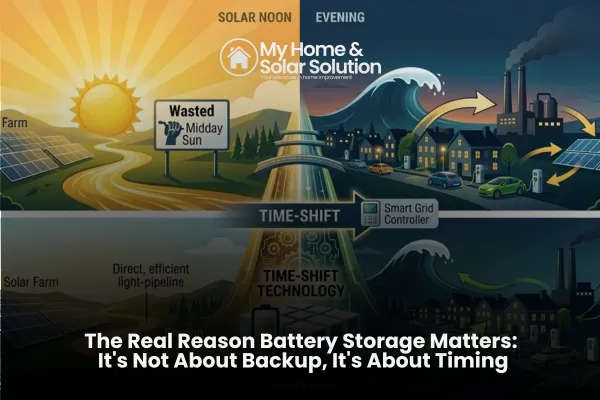
The Real Reason Battery Storage Matters: It's Not About Backup, It's About Timing
The Real Reason Battery Storage Matters: It's Not About Backup, It's About Timing
Ask most homeowners why they'd want a home battery, and the answer is usually some version of "for when the power goes out." Backup power is a real and valuable benefit — but for the typical California homeowner, it's not actually where most of the financial value comes from. The bigger story is timing.
The Timing Problem Solar Alone Doesn't Solve
Solar panels generate the most electricity in the middle of the day, when the sun is highest. But most California households use the most electricity in the late afternoon and evening — when people get home, turn on air conditioning, start cooking, and plug in EVs. Without storage, a solar-only home typically sends much of its midday production back to the grid (often for a relatively low credit under California's Net Billing Tariff) and then buys expensive grid power again a few hours later to cover the evening peak. This mismatch between when solar is produced and when electricity is actually needed is the core problem a battery solves.
The Time-of-Use Rate Structure Makes This Matter More
California utilities have moved aggressively toward time-of-use (TOU) rate plans, where the price of electricity varies dramatically by hour. Peak pricing windows — typically 4 to 9 p.m. — can cost two to three times more per kilowatt-hour than midday or overnight rates. For a solar home without a battery, that evening peak window is precisely when you're most likely to be buying expensive grid power, even though your panels produced plenty of cheap electricity just a few hours earlier. Curious whether you qualify for California's Net-Billing rate plan? Check your eligibility and current CPUC rates at myhomesolution.org/california_public_utility_commissions.
A home battery captures that midday solar generation and holds it until the evening peak, letting you use your own previously-generated power instead of buying grid electricity at the most expensive time of day. This is functionally a form of arbitrage — capturing a price spread by shifting when you "spend" your electricity.
Running the Numbers
Consider a household that produces excess solar energy worth, say, 8 cents per kWh in export credits at midday, but would otherwise pay 45-50 cents per kWh for grid power during the evening peak. Every kilowatt-hour that gets stored and used internally rather than exported and rebought represents a substantial daily savings — one that recurs every single day, rain or shine, regardless of whether there's ever an actual power outage.
Lower your electric bill by 50% without leasing, financing or paying cash for solar and battery storage
Backup Power Is a Bonus, Not the Main Event
None of this diminishes the value of backup power during outages, which matters enormously for medical equipment, food safety, and basic comfort during multi-day events like wildfire-related power shutoffs. But for most homeowners evaluating whether a battery is worth the investment, the daily timing arbitrage — not the occasional outage — is what actually drives the payback math. A home battery's biggest financial contribution isn't sitting idle waiting for an outage. It's working every single day, shifting cheap midday solar into the expensive evening hours when the grid charges the most. Understanding that distinction changes how homeowners should evaluate battery sizing, system design, and the real return on investment.
Curious whether you qualify for California's Net-Billing rate plan? Check your eligibility and current CPUC rates at myhomesolution.org/california_public_utility_commissions.

