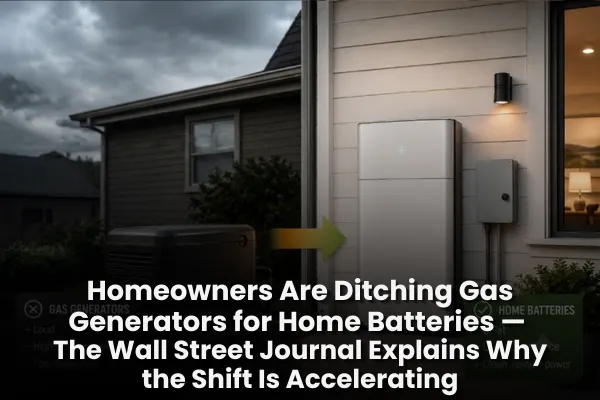
Homeowners Are Ditching Gas Generators for Home Batteries — The Wall Street Journal Explains Why the Shift Is Accelerating
Homeowners Are Ditching Gas Generators for Home Batteries — The Wall Street Journal Explains Why the Shift Is Accelerating
For decades, the backup power solution for California homeowners was simple: a portable gas generator, a few jerry cans of fuel, and a loud, smelly machine that came out of the garage when the lights went out. That era is ending. Not because gas generators stopped working — they still do what they've always done. But because home batteries have crossed a threshold where, for many California homeowners, they're simply the better option in almost every way that matters.
The Wall Street Journal has reported on the accelerating shift from gas generators to home battery systems, noting that battery storage installations have surged alongside growing consumer awareness of their advantages. The trend reflects a broader recognition that the technology has matured — and that the economics, convenience, and capability of home batteries now compare favorably to fossil fuel alternatives.
Here's an honest comparison of both options, and why the shift makes particular sense for California homeowners.
What a Gas Generator Actually Provides
-A gas generator's advantages are real and well-established:
High power output: A 7,500–10,000W portable generator can run a central air conditioner, refrigerator, and key lights simultaneously.
-Long runtime: With adequate fuel supply, a generator can run as long as you're willing to keep it fueled.
-Relatively low upfront cost: A quality portable generator runs $800–2,500. A standby whole-home generator is $10,000–20,000 installed.
-No dependency on solar: A generator works regardless of weather or sun availability.
The limitations are equally real — and in California's specific context, they're significant.
The Problems With Gas Generators for California Homeowners
-Fuel availability during disasters: The most dangerous assumption about gas generators is that fuel will be available when you need it. During a PSPS event or wildfire evacuation, gas stations frequently run out of fuel, have extended lines, or lose power themselves (meaning their pumps don't work). Homeowners with generators and no stored fuel have found themselves unable to run their backup power source when they need it most.
-Noise: A portable generator running at full load produces 65–75 decibels — roughly equivalent to a vacuum cleaner, running continuously, often within earshot of sleeping family members and neighbors. Some HOAs and local ordinances restrict or prohibit nighttime generator operation.
-Emissions and indoor safety: Carbon monoxide from generators kills dozens of Americans annually when operated in or near enclosed spaces. Running a generator requires careful placement, outdoor operation, and vigilance — particularly at night when families are asleep.
-Maintenance: Gas generators require regular maintenance — oil changes, carburetor cleaning, fuel stabilizer in stored gasoline, annual service. A generator that hasn't been started in six months may not start when you actually need it.
-California's specific fire risk environment: In the wildfire context, operating a gas-powered machine in dry, high-wind conditions carries its own risk. Spark arrestors and proper placement are essential — and not everyone follows the precautions.
Why Home Batteries Are a Better Fit for Most California Families
Home batteries address every major limitation of gas generators:
-No fuel dependency: A solar-charged battery recharges every day, rain or shine (mostly shine, in Southern California). You have no fuel logistics to manage, no jerry cans to store, no gas station lines to navigate.
-Silent operation: A Tesla Powerwall makes no noise. Zero. You can have a normal conversation standing next to it. Your neighbors won't know it exists.
-Zero emissions: No carbon monoxide risk. No exhaust. Safe to operate in an enclosed garage or utility closet.
-Maintenance-free: Home batteries have no moving parts, no fluids, and no annual service requirements. The manufacturer's warranty typically covers 10 years with minimal degradation.
-Automatic operation: A battery with automatic transfer switch functionality switches to backup mode in milliseconds — before you've even noticed the grid is down. No going to the garage, no starting a machine, no transfer switch management.
-Battery capacity is limited relative to a generator that can run indefinitely with fuel. A single Powerwall covers critical loads for 12–24 hours without solar; a generator runs as long as you fuel it. For homeowners with moderate backup needs and solar panels, batteries are unambiguously superior. For homeowners needing very high sustained power output over many days without solar, a hybrid approach — battery plus generator — can make sense.
The Cost Picture
The upfront cost comparison between batteries and generators has historically favored generators significantly. That gap has narrowed.
A quality standby whole-home generator (10kW+) installed costs $12,000–20,000, plus ongoing maintenance. A Tesla Powerwall system installed through a purchase runs $12,000–18,000 for one to two units — with the 30% federal tax credit reducing net cost to $8,400–12,600. Through TPO programs with no upfront cost, the battery is installed at zero down with savings from day one.
Over 10–15 years accounting for fuel costs, maintenance, and installation, the total cost of ownership between a whole-home standby generator and a solar-plus-battery system is comparable — with the battery delivering additional monthly bill savings the generator never provides.
For California homeowners who are also going solar, the battery is not an add-on cost. It's part of an integrated system that lowers your monthly bill while providing backup — a dual benefit no generator can match.
What the Shift Means for Your Home
Home batteries are increasingly being recognized not just as backup devices but as long-term home assets. California home buyers are increasingly aware of battery backup as a value driver — a home that stays powered during PSPS events is a meaningfully more attractive property in this market.
Gas generators don't add to home value. A well-documented solar-plus-battery installation does.
My Home & Solar Solutions helps qualifying California homeowners access solar and battery backup — including Tesla Powerwall systems — through programs with no upfront equipment cost. We cover Ventura County and the broader Southern California market, and we help homeowners understand the full picture before they make any decision.
Visit https://myhomesolution.org/california_public_utility_commissions to find out if your home qualifies. The shift away from gas generators isn't just a trend — it's a rational response to a California energy environment that rewards clean, reliable, home-based power.

