Why Batteries Pay for Themselves Through Arbitrage Not Just Backup
Why Batteries Pay for Themselves Through Arbitrage Not Just Backup
When homeowners try to decide whether a battery storage system is worth the investment, the conversation often defaults to outage protection: how often does the power go out, and how much is that protection worth? It's a reasonable question, but it overlooks the financial mechanism that actually drives most battery payback calculations — daily price arbitrage.
What Arbitrage Means in This Context
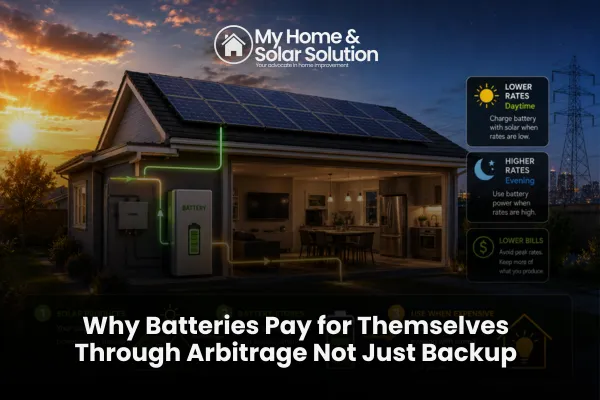
In financial markets, arbitrage means profiting from a price difference between two markets or two points in time. Home battery storage works on a similar principle: a battery lets you "buy low and use high" on electricity, without ever touching a trading account. Specifically, a home battery charged by solar panels captures electricity at essentially no marginal cost during the day. It then discharges that stored electricity during the evening peak hours, when California's time-of-use rates are at their highest — often two to three times higher than midday or overnight rates. Every kilowatt-hour shifted this way represents pure savings: the difference between what you would have paid the utility for that peak-hour electricity, and the near-zero cost of generating it yourself at midday.
Why This Happens Every Single Day
Curious whether you qualify for California's Net-Billing rate plan? Check your eligibility and current CPUC rates at myhomesolution.org/california_public_utility_commissions.
This is the critical distinction from backup power. An outage might happen a handful of times a year, if at all, in many areas. But the price spread between off-peak and on-peak electricity exists every single day, rain or shine, summer or winter, whether or not there's ever an outage. A battery sized appropriately for a home's usage pattern captures this daily spread automatically, accumulating savings far more frequently and predictably than backup power scenarios would ever provide on their own.
Running the Numbers
Consider a household that shifts roughly 10 kWh of consumption from peak to off-peak pricing each day through battery storage. If the price spread between off-peak/solar-generated power and peak grid rates is around 35-40 cents per kWh, that's $3.50-$4.00 in daily savings, compounding to well over $1,000 annually — entirely independent of whether the grid ever goes down. Multiply that across a typical battery's 10+ year lifespan, and the arbitrage value alone often justifies the investment well before backup power is factored in at all.
What This Means for Evaluating a System
Homeowners comparing battery quotes should ask installers to model expected arbitrage savings based on their actual time-of-use rate plan and usage patterns, not just a generic backup-power pitch. The real financial case for most California households rests on this daily, predictable value — backup power is a meaningful bonus, not the primary driver of payback. Home batteries pay for themselves primarily through daily price arbitrage — capturing cheap, self-generated midday power and using it during expensive evening peak hours — not through occasional backup power during outages. Understanding this distinction helps homeowners evaluate battery proposals based on the metric that actually drives most of the financial return.
Curious whether you qualify for California's Net-Billing rate plan? Check your eligibility and current CPUC rates at myhomesolution.org/california_public_utility_commissions.

