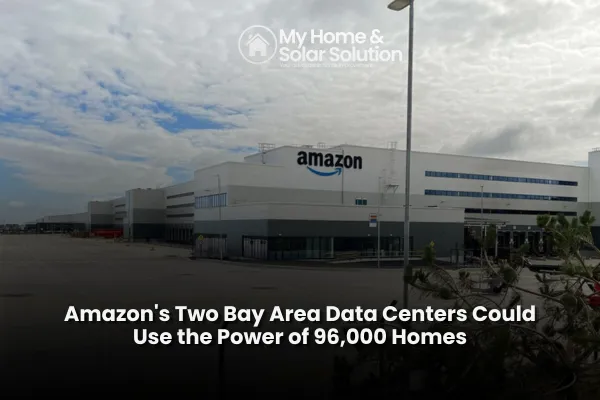
Amazon's Two Bay Area Data Centers Could Use the Power of 96,000 Homes
Amazon's Two Bay Area Data Centers Could Use the Power of 96,000 Homes
Amazon Web Services, the cloud computing arm of Amazon, operates data centers in the Bay Area that together draw as much power as a mid-sized city. Its Mission College facility in Santa Clara is rated at about 39 megawatts, and a facility in Hayward is rated at about 49 megawatts.
Doing the math
At full power year-round, the Santa Clara site's 39 megawatts equals about 342 million kilowatt-hours, or roughly 42,700 homes' worth of electricity at 8,000 kilowatt-hours per home. The Hayward site's 49 megawatts equals about 429 million kilowatt-hours, or roughly 53,700 homes. Together, that is about 96,400 homes' worth of electricity from just two facilities.
More are coming
These sites are part of a fast-growing pipeline. Data center developers had requested about 15,000 megawatts from PG&E by the end of 2025. Other planned Santa Clara projects include four Prologis facilities at 99 megawatts each and a planned 99-megawatt Microsoft campus in San Jose.
Why it matters for your bill
Every new data center adds demand that the grid has to serve around the clock, including during the hot evening hours when California's grid is most stressed and electricity is most expensive. Serving that demand requires new infrastructure, and consumer advocates have warned that ratepayers could end up covering costs if projects fall short. California electricity already averages about 30 cents per kilowatt-hour, second only to Hawaii. Homeowners should plan for continued pressure on rates as demand grows.
Which side of the meter will you be on?
As AI and cloud computing drive demand higher, homes will land on one of two sides. On the buying side, you pay the grid's price during every peak. On the supply side, you produce your own solar power, store it in a battery, and send extra electricity back to the grid for compensation. Some homeowners do not love the idea of supplying power to a grid that serves cloud giants. But it is better than being on the other side of the meter, buying from the same crowded grid.
How homeowners are making the switch
Through third-party ownership programs, qualifying California homeowners can get solar and battery storage without buying or financing equipment. The battery covers expensive evening hours, extra energy earns bill credits, and California's SB 913 directs regulators to value battery power sent to the grid during high demand.
The takeaway
Amazon's two Bay Area data centers can use as much electricity as tens of thousands of homes. Homeowners can protect themselves by producing and storing their own power, with savings that can reach up to 40 percent compared with utility rates, depending on the home and program.
To find out if your home qualifies for a TPO solar and battery program, visit myhomesolution.org/california_public_utility_commissions

