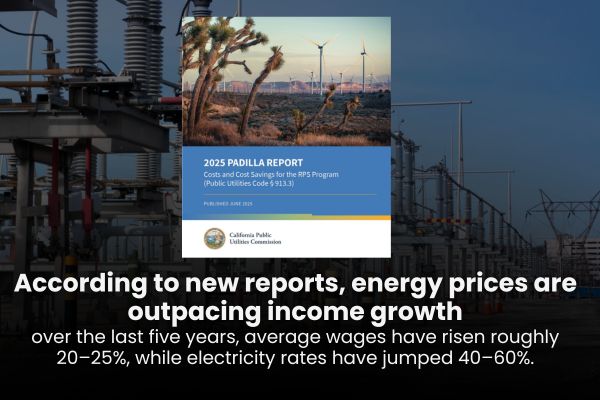
According to new reports, energy prices are outpacing income growth over the last five years, average wages have risen roughly 20–25%, while electricity rates have jumped 40–60%
If you feel like your electric bill in California is rising faster than everything else in your life, the latest numbers back you up. State data and recent reports all point in the same direction: power prices are climbing much faster than inflation and typical wage growth and the way our system is set up almost guarantees that trend continues.
1. What’s actually happening to your bill
For customers of SCE, PG&E, and SDG&E, the “all‑in” price of electricity, including energy, transmission, and distribution has roughly doubled over the past decade, and in some cases much more.

Historical CPUC cost data show that the bundled system average rate (the average price per kilowatt‑hour charged to full‑service customers) has climbed sharply:
At Southern California Edison (SCE), the average rate rose from about 14–15¢/kWh in the mid‑2000s to roughly 26.9¢/kWh by 2024.
At PG&E, it climbed from around 13–14¢/kWh to about 36.6¢/kWh over the same period — well over a 100% increase.
SDG&E’s average price similarly increased from the mid‑teens to the low‑30¢/kWh range by 2024.
Independent price trackers and rate reports confirm that, once more recent increases are factored in, many California IOU residential customers now pay in the high‑20s to mid‑30s cents per kWh, roughly double the U.S. average.
In other words, even if you don’t change how much electricity you use, the price of each unit has gone way up — which is why your total bill keeps climbing.
2. Why electricity prices are outrunning inflation and wages
A lot of technical jargon gets thrown around about rate cases, revenue requirements, and policy mandates. The simple version is this:
Utilities add up all their costs, regulators approve a total dollar amount they’re allowed to collect, and then that amount is spread over the electricity sold — mostly as a charge on each kWh.
Several big forces are pushing that total dollar amount up:
Wildfire safety and grid hardening
Utilities are spending billions on vegetation management, fire‑resistant poles and wires, undergrounding lines, and recovering past wildfire and storm costs. Those costs go straight into the revenue requirement that rates must cover.Aging and expanding infrastructure
Replacing old equipment, adding new transmission and distribution, and preparing for electric vehicles and new data‑center loads all add to “rate base” — the pool of assets the utility earns a regulated profit on. More rate base means more dollars that have to be collected from customers each year.Clean‑energy mandates (RPS)
California’s Renewables Portfolio Standard requires 60% of retail electricity sales to come from renewables by 2030, moving to 100% clean electricity by 2045. A recent CPUC “Padilla Report” on RPS costs shows that utilities’ spending on renewable contracts has been rising, and that new RPS contracts signed in 2024 were significantly more expensive than those in 2023 in real terms. The report also highlights that RPS energy now makes up a very large share of IOU generation spending.Program add‑ons
Discounts for low‑income customers, energy‑efficiency programs, electric‑vehicle infrastructure, and other public‑purpose programs are all funded through your bill as well.
Under California’s regulatory model:
Regulators approve a revenue requirement that bundles all of these costs plus a regulated profit margin.
Instead of collecting most of that money as a flat monthly fee, the state has chosen to load the majority of it into the per‑kWh price.
When total costs rise faster than sales, the only way to hit the revenue target is to raise the price on each kilowatt‑hour.
Meanwhile, typical California incomes and cost‑of‑living adjustments have grown only modestly faster than general inflation nowhere near the 80–160% increases seen in some IOU rate histories. That’s why it feels like your electric bill is “running away” from your paycheck.
3. What this means for you — and the only realistic ways to respond
For the average Californian, the picture looks like this:
Yes, rates are going up faster than inflation.
Historical CPUC data and state‑level price reports show that electric prices have grown much faster than general consumer prices over the last decade.Yes, rates are going up faster than most income growth.
Analyses by state fiscal offices and energy economists have noted that while wages have risen, they haven’t kept pace with the steep jumps in electric rates since around 2015.And no, there’s no quick fix coming from above.
The core drivers — wildfire risk, infrastructure needs, decarbonization mandates, and the cost‑of‑service model — aren’t going away. At best, regulators can slow the rate of increase; they can’t simply cut rates in half without also slashing investments that are currently seen as necessary.
That leaves you with a practical question:
How much of this rising‑rate risk do you want to keep on your own bill?
In practice, there are only two levers most customers can realistically pull:
Buy fewer utility‑priced kWh.
Rooftop solar, community solar, and aggressive efficiency (heat‑pump water heaters, high‑SEER AC, better insulation, etc.) all reduce the number of kilowatt‑hours you buy from the utility at 30–40¢.
If you’re a homeowner, pairing solar with a battery matters more than ever under current time‑of‑use and net‑metering rules, because it lets you shift your own solar into the evening peak when the grid is most expensive.
Get paid for helping the grid.
Virtual power plant (VPP) and grid‑resilience programs aggregate thousands of home batteries and other devices and dispatch them when the grid is stressed.
In exchange, participants can receive bill credits or payments for allowing limited, controlled use of their battery during specific events.
That turns you from just a ratepayer into a small power plant: you draw fewer kilowatt‑hours from the utility and sometimes get paid for the flexibility you provide, while also having backup power during outages.
As long as the current utility and regulatory structure stays in place, the data say the same thing: electricity will likely keep getting more expensive in nominal terms, and faster than many people’s incomes. The only way to stop that from hitting your personal budget at full force is to change how much you buy from the utility — and, where possible, get the grid to start paying you back.
Sources
Historical bundled system average rates, revenue requirements, retail sales, and rate base for SCE, PG&E, and SDG&E (Excel download).
CPUC “Historical Electric Cost Data” landing page (system‑average costs and related metrics).
CPUC 2025 Padilla Report on RPS Costs and Cost Savings (RPS expenditures, contract prices, and portfolio cost per kWh).
CPUC 2025 RPS Annual Report to the Legislature (RPS targets, utility progress, and transmission context).
CPUC “Electric Rates” overview (explanation of how revenue requirements are translated into rates).
Public Advocates Office Electric Rates Reports (Q4 2024 and 2025 quarterlies) on recent IOU rate increases.
Energy Institute at Haas: “Reining in California’s Runaway Electricity Rates” (analysis of structural drivers of high rates).
California LAO: “Residential Electricity Rates in California” (comparison of rate growth, bills, and affordability).
U.S. EIA “Electric Power Monthly” – Average retail electricity price by state (California vs. U.S. averages).

