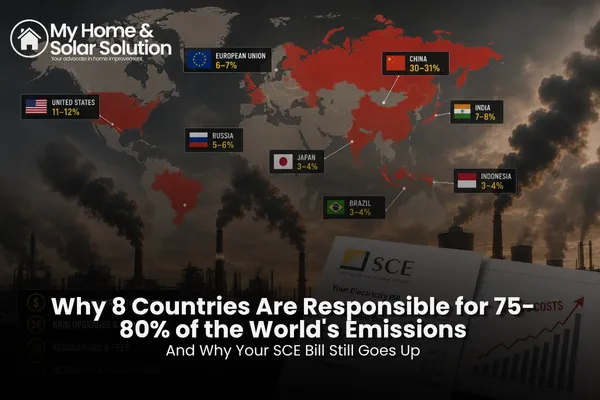
Why 8 Countries Are Responsible for 75-80% of the World's Emissions — And Why Your SCE Bill Still Goes Up
Why 8 Countries Are Responsible for 75-80% of the World's Emissions — And Why Your SCE Bill Still Goes Up
It's a striking fact: according to International Energy Agency data, just two groupings of countries — the wealthy, industrialized OECD nations and the four major emerging economies known as BRIC (Brazil, Russia, India, and China) — together account for roughly 75-80% of all global CO2 emissions. The vast majority of the world's nearly 200 countries contribute comparatively little to the global total. So if global emissions are this concentrated among a handful of major economies, why does your Southern California Edison bill keep climbing every year? The answer is that global emissions politics and your local electric bill are, for the most part, two completely separate stories.
What's Actually Driving Your SCE Bill
California's investor-owned utilities operate under a regulatory model where they're allowed to recover the cost of approved infrastructure investments, plus a guaranteed rate of return, through customer rates. The specific cost drivers behind recent SCE rate increases include: Wildfire mitigation and liability. Years of devastating wildfires linked to utility equipment have led to billions of dollars in settlements, lawsuits, and mandated grid-hardening projects — undergrounding power lines, vegetation management, and equipment upgrades — all of which get built into the rate base. Grid modernization. Aging transmission and distribution infrastructure requires constant investment to maintain reliability, especially as electricity demand grows from EVs, building electrification, and new commercial loads. Regulatory and program costs. State-mandated programs, from energy efficiency initiatives to low-income assistance programs, are funded in part through utility rates.
Curious whether you qualify for California's Net-Billing rate plan? Check your eligibility and current CPUC rates at myhomesolution.org/california_public_utility_commissions.
None of these cost drivers have anything to do with whether China, the United States, or any other country is reducing its emissions on a global scale. They are local, California-specific, infrastructure and liability costs that exist regardless of what's happening with global climate diplomacy.
The Disconnect, Explained
This is a common point of confusion — and frankly, frustration — for homeowners. Global emissions reduction is a slow-moving, decades-long international policy challenge involving dozens of governments and competing economic interests. Your electric bill, on the other hand, reflects decisions made by California regulators about what costs utilities are allowed to recover from customers right now. Even if every country on Earth dramatically cut emissions tomorrow, California's wildfire liability costs, aging grid infrastructure, and growing electricity demand wouldn't disappear. Conversely, even if global emissions kept rising, a California utility focused on grid hardening and reliability could still deliver genuinely safer, cleaner power locally.
What Homeowners Can Actually Control
Since your bill is driven primarily by local infrastructure and liability costs rather than global emissions trends, the most effective lever homeowners have isn't a global policy outcome — it's reducing how much of that locally-priced grid power you need to buy in the first place. Solar and battery storage let you generate and store your own electricity, directly reducing your exposure to rate increases tied to wildfire costs, grid investments, and demand growth — regardless of what's happening on the global stage.
Bottom Line
Global emissions are concentrated among a small number of major economies, but that fact has little direct bearing on why your California electric bill keeps rising. Wildfire liability, grid modernization, and rising local demand are the real drivers — and they're the reasons solar and battery storage continue to make financial sense for California homeowners, independent of how the broader climate conversation unfolds.
Curious whether you qualify for California's Net-Billing rate plan? Check your eligibility and current CPUC rates at myhomesolution.org/california_public_utility_commissions.

